

A GUIDED WORKBOOK
MAKING ROOM
For boundaries, patterns, and belonging
Explore the roles, expectations, and relationship patterns you may have learned—and decide what still fits.
Curiosity before judgment.
Understanding before change.
BOUNDARY WORK THAT MAKES ROOM FOR CONTEXT
Making Room considers how family roles, culture, belonging, caregiving, past experiences, and the need for connection may shape the patterns we carry. It helps readers understand what a pattern protected, consider what it costs now, and practice responses that fit their values, relationships, and circumstances.
CHOOSE WHAT FITS
Two Ways to use Making Room
PERSONAL EDITION
For Individual Reflection
The 32-page client workbook is a guided resource to complete at your own pace. Use it to explore learned roles, expectations, relationship patterns, and boundaries. Type directly into the fillable PDF or print it and write by hand.
Fillable and printable PDF
Checklists, reflections, and boundary exercises
Personal-use license
Immediate digital access
$29
PROFESSIONAL EDITION
For Clinicians
The same 32-page fillable and printable client workbook, paired with a 37-page Clinician Guide for use in clinical practice.
Worksheet-by-worksheet clinical guidance
Questions to deepen collaborative exploration
Culturally and contextually responsive considerations
Permission to provide materials to clients in your own caseload
Single-clinician professional-use license
Immediate digital access
$49
Need access for multiple clinicians or an organization?
INSIDE THE WORKBOOK
What you’ll explore
Move through the workbook in order, choose only the pages that feel relevant, or return to particular exercises over time. There is no requirement to complete every page.
Notice the Pattern
01
Name what you are carrying and the roles you learned to play.
Explore family, culture, belonging, and protective purpose.
02
Understand the Context
Notice emotional, cognitive, and body-based information.
03
Recognize Your Signals
Develop communication and boundaries that fit the context.
04
Practice a Different Response
Choose one manageable step and identify meaningful support.
05
Integrate
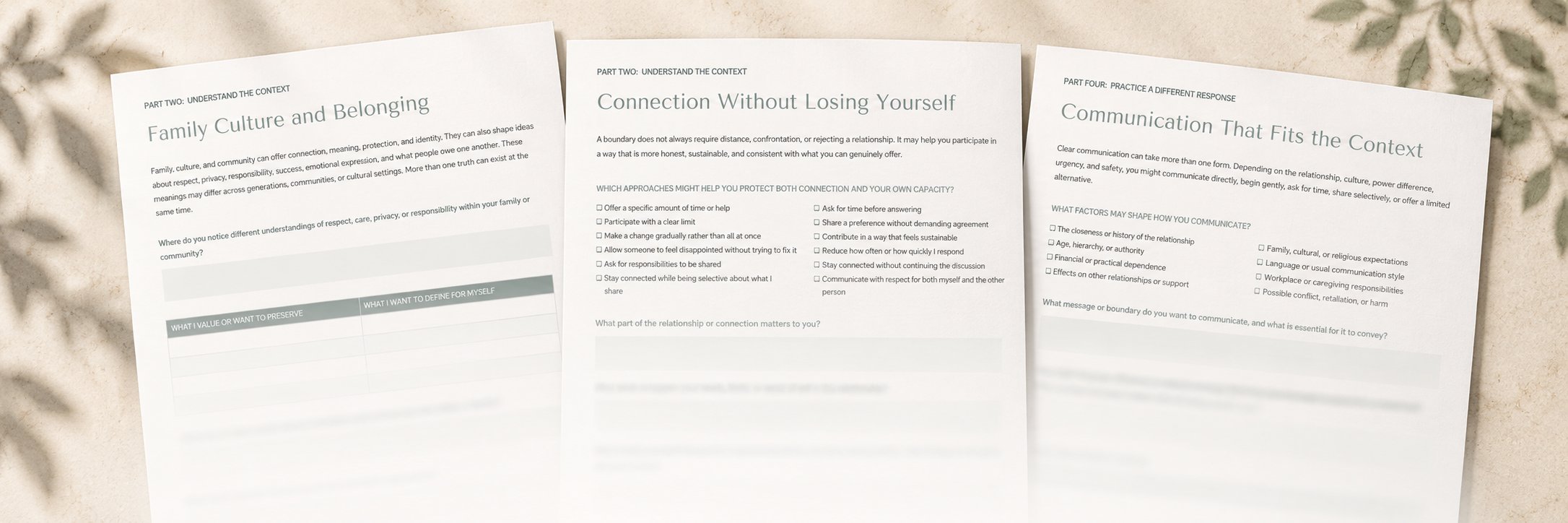
Thoughtful prompts. Practical exercises.
A Culturally Responsive Approach
Boundaries do not exist outside of relationships and context. Making Room avoids treating directness, distance, or independence as the only signs of healthy change. It invites readers to consider family roles, cultural values, caregiving responsibilities, language, power, safety, and practical consequences while identifying choices that feel sustainable and true to themselves.

Ready to Begin?
Find the version of Making Room that’s right for you.